Agricultural Building Spray Foam Insulation in Watsonville, CA
Watsonville Spray Foam Insulation provides spray foam insulation for appropriate agricultural and farm-support buildings in Watsonville and the Pajaro Valley, with scope based on building use, substrate, ventilation, moisture, fire-code requirements, and project goals. We bring 10+ Years of Experience and are Insured.
The Pajaro Valley's agricultural context means many properties include farm-support, storage, and metal structures that may benefit from insulation where the building use and assembly allow it. We do not invent farms, growers, packing houses, clients, crop types, or specific completed projects, and spray foam is not assumed appropriate in direct food-contact, animal, chemical, or washdown environments without project-specific evaluation.
Each agricultural-building project starts with a building-use and assembly assessment that looks at substrate condition, ventilation, moisture, fire-code requirements, and the structure's purpose before any foam is recommended. The fastest way to begin is a call to 831-432-7982, or you can submit the five-field form on this page with your project address.
Request an Agricultural Building Spray Foam Estimate
Tell us about your property and the insulation work you need. Include your project address so we can determine serviceability in Watsonville and the Central Coast. We review each request and reach out to discuss scope, materials, and next steps.
- Five-field request form — no unnecessary fields
- SMS consent is optional and never required to request an estimate
- Project-specific pricing after scope evaluation
Request My Estimate
Request your free spray foam insulation estimate. 10+ Years of Experience • Insured.
Why Watsonville Property Owners Choose Watsonville Spray Foam Insulation for Agricultural Building Spray Foam
Watsonville Spray Foam Insulation brings 10+ Years of Experience and is Insured, serving Watsonville, the Pajaro Valley, and the Central Coast with assembly-specific spray foam and insulation work.
Our Agricultural Building Spray Foam Services
Agricultural Storage Buildings
Agricultural storage buildings in the Watsonville and Pajaro Valley area may benefit from spray foam where the building use, substrate, and access support it. These farm-support and storage structures are evaluated for the specific building rather than assumed.
Foam is applied to appropriate wall and roof assemblies with material and thickness selected for the building use, substrate, and applicable code. Ventilation and moisture strategy are evaluated as part of the storage-building scope.
Property owners gain insulation that supports interior temperature control for the agricultural storage building, with expectations set by the actual assembly and building use.
Metal Farm-Support Buildings
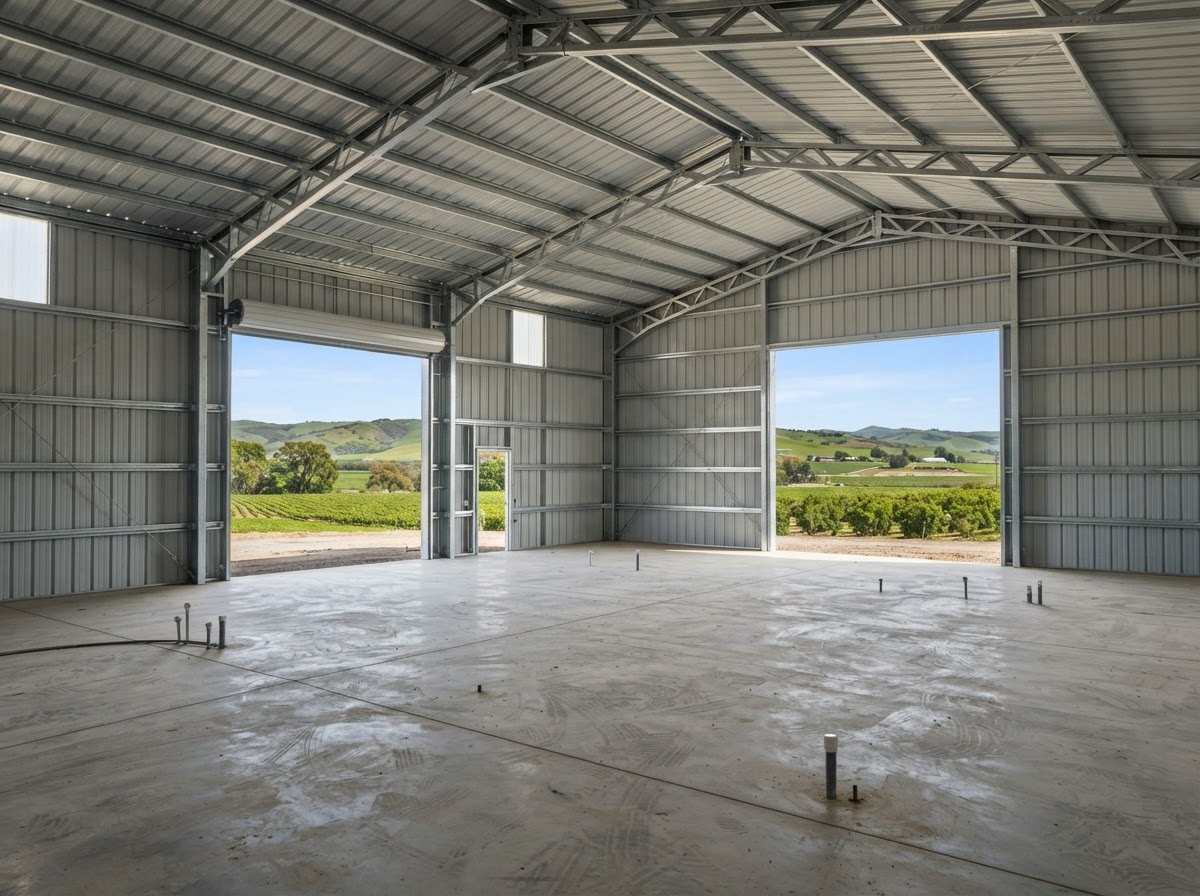
Metal farm-support buildings in the Pajaro Valley may benefit from spray foam where the steel assembly, building use, and access support it. Panel condition, corrosion, and active leaks are assessed before any interior foam is recommended.
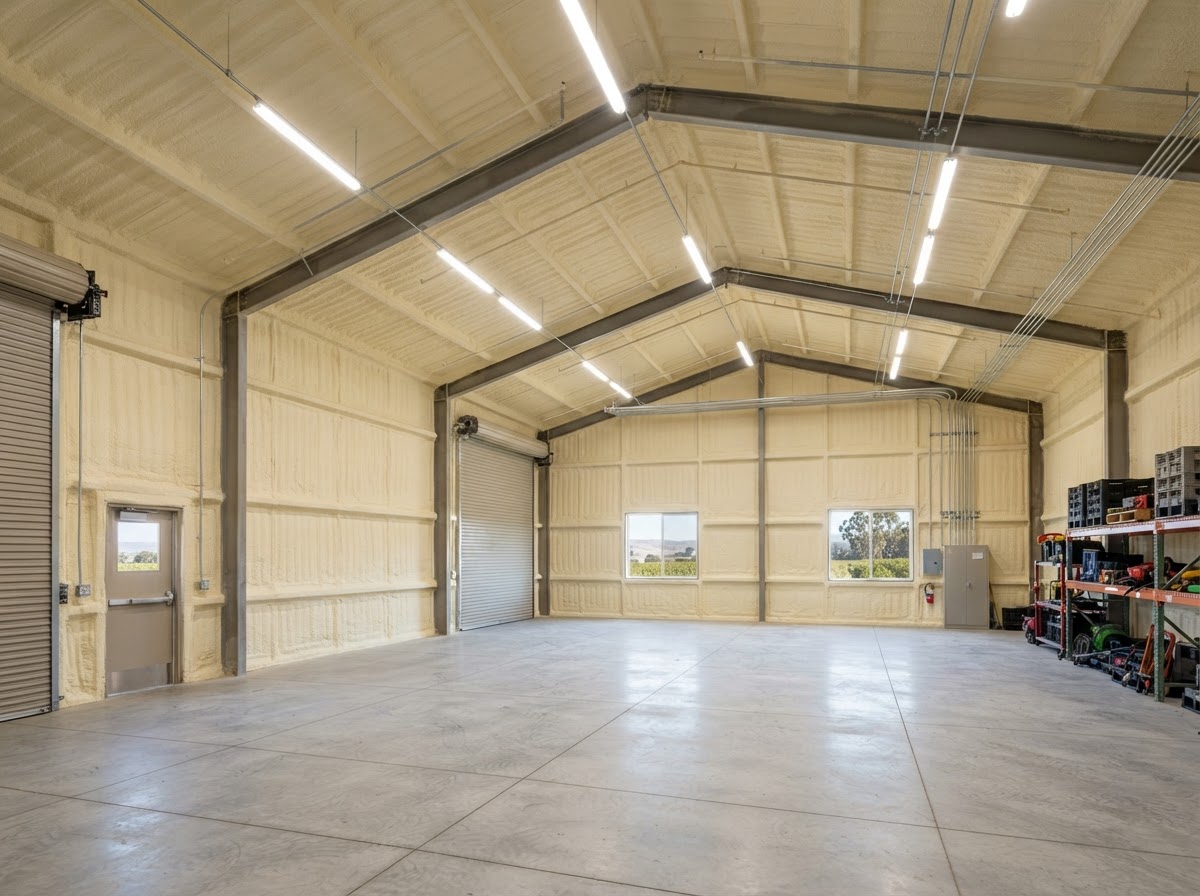
Foam is applied to the interior steel substrate with material and thickness selected for the panels, framing, and applicable code. Air leakage and condensation-control strategy are evaluated without a promise of condensation elimination.
Property owners gain an interior insulation layer for the metal farm-support building, supporting temperature control and air-sealing when correctly specified for the structure and its use.
Workshops and Equipment Buildings
Workshops and equipment buildings in the Watsonville area may benefit from spray foam where the assembly, building use, and access support it. These structures are evaluated for the specific building and its purpose rather than assumed.
Foam is applied to appropriate wall and roof assemblies with material and thickness selected for the building use and fire-code requirements. We do not invent operations or specific completed projects.
Property owners gain insulation that supports interior temperature control for the workshop or equipment building, with expectations set by the actual assembly and use.
Agricultural Remodels and New Construction
Agricultural remodels and new construction apply spray foam to exposed assemblies in Watsonville and Pajaro Valley farm-support buildings where the framing is accessible. Sequencing insulation while the framing is open avoids the access limitations of retrofit work.
Foam is applied to open framing with coordination around the construction schedule, building use, and applicable code. Material and thickness are selected for the assembly, with barrier and ventilation requirements addressed per the building.
Property owners gain insulation integrated into the remodeled or new agricultural building, supporting the building envelope from the start of the project rather than as a retrofit.
What Problems Can Agricultural Building Spray Foam Address?
Air Leakage Through Building Assemblies
Air leakage through agricultural building assemblies can undermine interior temperature control. Spray foam can form an air-sealing layer at accessible surfaces, but the leakage source and substrate should be evaluated before a scope is prescribed.
Difficult Metal or Framed Cavities
Difficult metal or framed cavities can leave gaps with conventional insulation. Spray foam conforms to the substrate and framing, which can suit difficult cavities where access is available and the building use allows it.
Thermal and Condensation-Control Challenges
Thermal and condensation-control challenges are common in agricultural metal structures in the Pajaro Valley's coastal climate. Spray foam can be part of a condensation-control strategy, but we do not promise condensation elimination, because moisture depends on ventilation, building use, and the full assembly.
What Are the Signs a Watsonville Property May Need Agricultural Building Spray Foam?
Building Use and Occupancy
Building use and occupancy must be evaluated before agricultural foam is installed. Direct food-contact, animal, chemical, or washdown environments require project-specific evaluation, because spray foam is not assumed appropriate for every agricultural use without assessing the building's purpose.
Moisture, Washdown or Leak Conditions
Moisture, washdown, or leak conditions must be checked before agricultural foam is installed. Active leaks and bulk-water entry must be diagnosed and corrected rather than concealed by insulation, because spray foam does not repair active water sources.
Ventilation, Barriers and Fire-Code Requirements
Ventilation, barrier requirements, and fire-code requirements must be checked before agricultural foam is installed. The building use, occupancy, and applicable code affect which foam, thickness, and barrier are appropriate for the agricultural assembly.
How Our Agricultural Building Spray Foam Process Works
Building-Use and Assembly Assessment
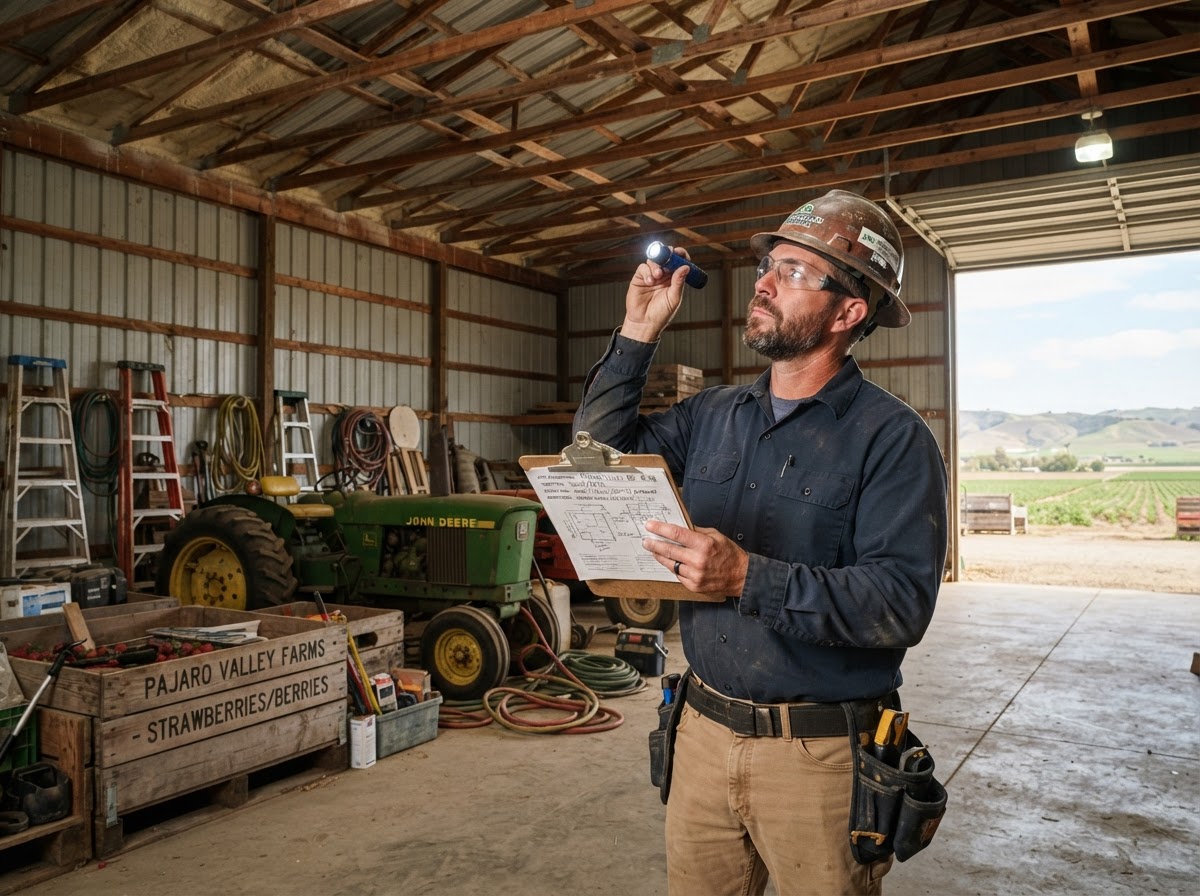
We assess the building use, substrate, panel and framing condition, moisture, ventilation, fire-code requirements, and your project goals. This informs whether spray foam is appropriate for the agricultural building and which foam fits the assembly.
Product and Scope Planning
We clarify the open-cell versus closed-cell choice, installed thickness, total wall and roof area, barrier requirements, and access. The selection is assembly-specific, and closed-cell is not assumed for every farm building.
Access, Protection and Scheduling
Preparation includes securing access equipment, protecting surfaces, isolating the work area, and scheduling around the building use. Height and access conditions are planned before installation proceeds.
Professional Installation
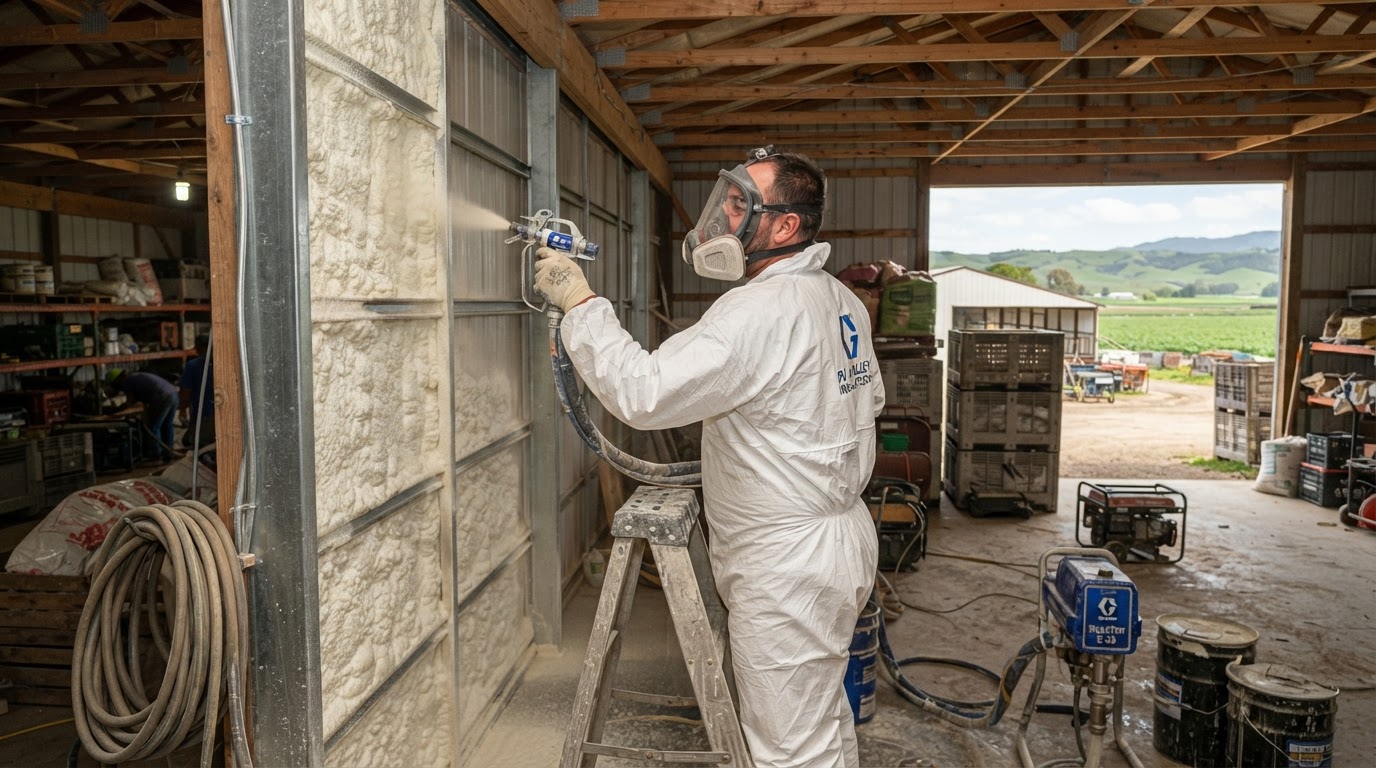
Professional application covers the substrate and assembly with spray polyurethane foam, conforming to the framing or steel panels, with coverage and trimming as part of quality control. We do not publish equipment settings or chemical-mixing steps.
Quality Review and Handoff
We review visual coverage and substrate condition, clean the work area, and follow manufacturer-specific curing and ventilation procedures. We hand off the completed scope with any next steps for the building use and ventilation.
Last updated: September 8, 2026
How Much Does Agricultural Building Spray Foam Cost in Watsonville?
Agricultural building spray foam insulation in Watsonville and the Pajaro Valley is commonly priced by board foot, with the total depending on foam type, installed thickness, total wall and roof area, building height, access equipment, preparation, building use, and the assembly.
Open-Cell Spray Foam Pricing
Open-cell spray foam: approximately $0.60–$1.60 per board foot
Notes: planning range only; actual pricing depends on product, thickness, total area, access, prep, and building use.
Closed-Cell Spray Foam Pricing
Closed-cell spray foam: approximately $1.30–$3.10 per board foot
Notes: planning range only; higher density and project-specific installed thickness influence material and labor requirements.
What Changes the Final Estimate?
- • Foam type (open-cell vs. closed-cell)
- • Building height and access equipment
- • Total wall and roof area
- • Specified installed thickness
- • Substrate condition and preparation
- • Building use and occupancy
- • Ignition or thermal barrier needs
- • Ventilation and fire-code requirements
- • Project scale and complexity
One board foot equals one square foot of coverage installed one inch thick. For example, 100 square feet at two inches thick equals 200 board feet.
These ranges are planning tools, not fixed quotes. Building use, substrate condition, foam type, installed thickness, access equipment, prep, barriers, and fire-code requirements can all affect price. We never convert a generic range into a fake whole-building total.
Get a Project-Specific Estimate
Submit your request with your project address and the service you need. We review the scope and provide project-specific pricing after evaluation — not a generic number from a range. Call 831-432-7982 for an immediate conversation.
Request My Estimate
Request your free spray foam insulation estimate. 10+ Years of Experience • Insured.
Agricultural Building Spray Foam FAQs for Watsonville
How much does agricultural building spray foam cost in Watsonville?
Agricultural building spray foam in Watsonville runs approximately $0.60–$1.60 per board foot for open-cell and $1.30–$3.10 per board foot for closed-cell as planning ranges. Actual price depends on building height, total wall and roof area, foam type, thickness, substrate, prep, building use, barriers, and ventilation planning. We never infer a whole-building total from this range.
Can spray foam be used in agricultural metal buildings?
Yes, spray foam can be used in appropriate agricultural metal buildings where the steel assembly, building use, and access support it. Panel condition, corrosion, and active leaks are assessed before any interior foam is recommended, and the selection is assembly-specific.
Is closed-cell foam always required for farm buildings?
Closed-cell foam is not always required for farm buildings. Closed-cell may be selected in some metal assemblies for its density and condensation-control characteristics, but the choice is assembly-specific and depends on building use, substrate, vapor strategy, and applicable code.
Can spray foam solve condensation problems?
Spray foam can be part of a condensation-control strategy, but it does not solve condensation problems as a guaranteed fix. Condensation depends on ventilation, building use, the full assembly, and interior conditions, so the strategy is evaluated for the specific building rather than promised as elimination.
Can spray foam be applied over active roof leaks or corrosion?
No, spray foam should not be applied over active roof leaks or corrosion. Active leaks and corroded substrate must be diagnosed and corrected before insulation proceeds, because spray foam does not repair active water sources or corroded panels.
What building-use factors matter before agricultural spray foam is installed?
Building use, occupancy, ventilation, and fire-code requirements matter before agricultural spray foam is installed. Direct food-contact, animal, chemical, or washdown environments require project-specific evaluation, because spray foam is not assumed appropriate for every agricultural use without assessing the building's purpose.
Do agricultural buildings require permits or fire-code review for spray foam?
Permit and fire-code requirements for agricultural spray foam depend on the project scope, building use, and jurisdiction. Requirements should be confirmed for the actual project and building before covered work proceeds, because fire-code and barrier obligations vary by building use and occupancy.
Request Agricultural Building Spray Foam in Watsonville
Call 831-432-7982 to talk through your project, or submit the form below with your project address and service request. 10+ Years of Experience and Insured, serving Watsonville and the Central Coast.
Request My Estimate
Request your free spray foam insulation estimate. 10+ Years of Experience • Insured.
Serving Watsonville & the Central Coast